Author Interview, Bethany Tucker

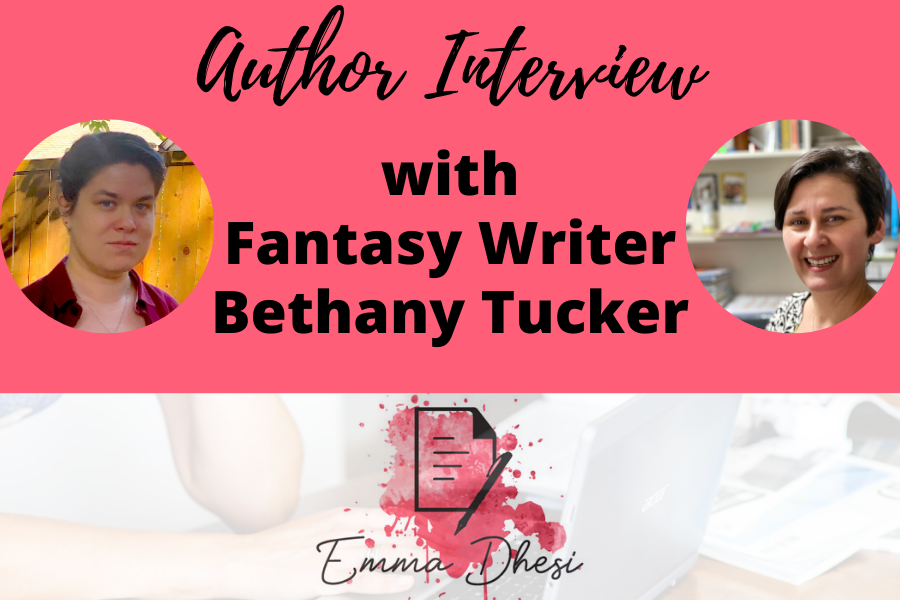
Author Interview, Bethany Tucker

Bethany Tucker is an author and editor located in Gig Harbor, WA, near Seattle. Story has always been a part of her life.

With over twenty years of writing and teaching experience, she’s more than ready to take your hand and pull back the curtain on craft and mindset.

Author Interview, Bethany Tucker

by Emma Dhesi | Turning Readers Into Writers

From time to time, I link to products or services I love using with affiliate links. This means that I may receive a small percentage or fee for referring you to any product you may purchase from one of those sites. It does not cost you anything. These small fees help sustain my small business. I truly appreciate your support.

Bethany wrote her first novel at the age of 13 and hasn’t looked back. She cannot imagine a life without writing in her life. 

She emphasises that writing is something you have to study, and she has studied it for years at home with all the advice that craft books could give her. She practiced diligently by writing every day.

She advises on how you can write around your other responsibilities. When she worked in Japan she used to cycle to and from work. It was while commuting she would mull on her stories, think about how she might tell them, and at lunchtimes she would take herself to a quiet space to put the words on a paper.

A wonderful tip she gives is to use your NET time to think about your stories. Washing the dishes? Folding laundry? In the shower? Use the time to think about your story.

When it comes to imposter syndrome, she advises that all you can do is try. You turn up to all other aspects of your life imperfect, writing is no different. 

While Bethany has an idea of her perfect writing day, she acknowledges she needs to be flexible because she has family responsibilities and must be able to adapt to those demands.


emma dhesi bethany tucker

She reminds you it’s easy to let other people take over your writing time, but she urges you to honour your boundaries and treat your writing time with respect.

Bethany used to be a discovery writer but now plots her stories because she sees plotting as ‘discovery writing on fast forward’.

She was once advised to ‘write to the end because only then do you know what the beginner looks like’. She says that changed her life!

Stay tuned until the end because Bethany will give you wonderful advice on how to manage fear, not just in writing but life.


Bethany offers a service call The First Five Package. It’s a critique service for beginner writers. She’ll assess your first 5,000 and send you back a personalised letter with where she thinks you need more guidance and resources you can turn to for that help.

You can find more here: https://theartandscienceofwords.com/author/bethanytuckerwriting/

Bethany writes Young Adult Fantasy under the pen name of Mustang Rabbit.

Not only has Bethany shared with you her years of advice and wisdom, but she is giving you the opportunity to get your hands on a copy of her YA book, Adelaide and the Dragon Castle. To claim your copy go HERE.

If you’ve been working on your novel for years (perhaps even decades) the maybe it's time to consider working with a coach.

If you have multiple versions of your novel and you don’t know which works best, are scared nobody will like your book and don't feel like a 'real' writer, then my guess is coaching is the right next step for you.

Find out more and sign up for your free Clarity Call here: https://emmadhesi.com/personal-coaching/

 

emma dhesi

Emma Dhesi writes women’s fiction. She began writing seriously while a stay at home mum with 3 pre-school children.

By changing her mindset, being consistent and developing confidence, Emma has gone from having a collection of handwritten notes to a fully written, edited and published novel.

Having experienced first-hand how writing changes lives, Emma now helps beginner writers find the time and confidence to write their first novel.
Story Structure Part 1: 3 Act Structure

Story Structure Part 1: 3 Act Structure

Story Structure Part 1: 3 Act Structure

by Emma Dhesi | Turning Readers Into Writers

The 3 Act Structure 

You’re new to writing, perhaps writing your first novel. You know there are different types of story structure, but it’s all a bit confusing and you’re not sure exactly how they differ. 

In this 3-part mini-series I’ll demystify the 3 most commonly used story structures: the 3 act structure, the hero’s journey and the 7 Point Story Structure. 

Today we will explore the 3 act structure. This is one of the oldest structures and originates from Greek tragedy. Needless to say it has been updated over the last two thousand years or so and is now most used by Hollywood to tell a story. 

What does this mean to you? Not a whole lot, except that it’s tried and tested, it’s a nice simple structure and is the one I teach my students.  

What is story structure anyway?  

Basically, it is the framework upon which you hang your novel. Structure gives your story backbone. It’s the set of rules upon which to build your story so that it resonates with readers, drawing them in and holding their attention until the end.  

From time to time, I link to products or services I love using with affiliate links. This means that I may receive a small percentage or fee for referring you to any product you may purchase from one of those sites. It does not cost you anything. These small fees help sustain my small business. I truly appreciate your support.

Act one – the set up  

This is the act in which you introduce your reader to the main characters and provide insight into their ‘normal’ life. 

This life might not a great life but it’s the life that your hero knows, and he or she wants to keep it that way. 

But for us to have a story to tell, your hero needs to be pushed out of their normal world whether they like it or not. And that is done using an inciting incident. 

For example, you have a character who likes to live a quiet life because they don’t feel confident out in the wider world. They feel like an outsider and so choose to stay at home and play computer games.  

Perhaps they’ve chosen to live a single life because a partner makes life messy. Nor do they get involved with their friend’s problems because, quite frankly, they don’t think it’s any of their business. 

However, the friend is involved with a drug gang and has named your hero as the guarantor. Something has gone wrong and unless the problem can be resolved, your hero is in the firing line. That’s why they have no choice but to accept the challenge put in front of them. 

This is the inciting incident. 

They could choose not to get involved, but if they don’t get involved there is a direct impact on their own life, i.e., get shot or worse. In order to maintain the status quo in the long term, your hero decides to take action, sort the problem, and return to their old life. 

What they don’t realise, is that when they decide take action and help their friend, their own life is propelled forwards and into the storyline. 

This is essentially the first act, and it is a relatively small act in your book. 

story structure 3 act structure

Act two: obstacles 

Act Two in the 3 act structure is the biggest act of the book and can be the hardest to write.  

In it you set up a series of problems your hero needs to overcome if they want to return to their old life. Don’t forget, the desire to return to that old life is their driving force. 

What they don’t realise is that as a result of the obstacles they’re overcoming, after being pushed into situations unforeseen and using talents they didn’t know they had, your character’s life has changed forever.  

There is no going back. They just don’t realise it yet! 

Increasing difficulty

The more your hero tries to get back to their old life, the more difficult it becomes. The easiest way to think about this is a series of three obstacles, each one bigger and more difficult to solve than the last. 

If we continue the example above, your hero’s first obstacle is to find out where their friend is hiding. This might involve visiting the friend’s parents. Something your hero really doesn’t want to do. 

The parents tell him that friend was last seen with another friend who is decidedly dodgy. 

This poses a bigger problem for our hero because he knows that the dodgy friend is a known drug dealer and someone your hero does not want to get involved with. He or she doesn’t take drugs, it doesn’t speak the lingo, it’s a world they know nothing about.  

But your hero is worried about their friend, so visits the dodgy friend. 

As you can imagine, our hero is very nervous, and the dodgy friend makes things very difficult for them. Your hero discovers their friend has gone to another city to hide. 

Now your hero needs to go to the other city and find their friend. Over the course of the novel your character has gone from someone who prefers to stay home to someone who is going to see a drug dealer. 

They are not only leaving their home but their city and mixing with known criminals who would not hesitate in killing them. 

So, as you can see in this hypothetical storyline, things are getting worse for hero. Each time they come up against an obstacle they have to dig deeper, be more resourceful and, without knowing it, change from the inside out. 

Act three: the resolution 

This is the smallest act in the 3 act structure, and is what brings the story to a conclusion.  

Act three begins at the end of the third obstacle, when your character has been pushed to their very limits. They have dug deeper than ever before. They have found their friend, solved the problem with the drug dealers and returned home safely. 

This act may be the smallest act but it is essential to get right if you want to leave your reader feeling happy and ready to read your next story.  

The stakes need to be high. 

Climax

At that climax things could go either way for your hero. They can either perish and everything goes wrong, or they can be successful and get what they want – either way your reader needs to feel your character is at a tipping point. 

Your hero also needs to have experienced personal growth.  

In our example the hero who wants to stay at home and reclaim to their quiet life has discovered they are stronger than they once thought.  

They have discovered that yes, life can get a bit messy, but it’s preferable to living a quiet, lonely, life. 

As a subplot, they may also have discovered a girl/boy which gives them the extra impetus to overcome their fears and take part in their own life. 

And of course, the resolution must solve the problem and have a “happy” ending. 

Examples of the three act structure 

The Hunger Games by Suzanne Collins 

Beloved by Toni Morrison 

The Fault In Our Stars by John Green 

If you find this helpful and would like more help with your writing journey, go to my Facebook group, Turning Readers Into Writers, click join and say hello. You’ll find a safe and friendly community of like-minded writers who want to write their first novel.

emma dhesi

Emma Dhesi writes women’s fiction. She began writing seriously while a stay at home mum with 3 pre-school children. 

By changing her mindset, being consistent and developing confidence, Emma has gone from having a collection of handwritten notes to a fully written, edited and published novel. 

Having experienced first-hand how writing changes lives, Emma now helps beginner writers find the time and confidence to write their first novel.
Story Structure Part 2: The Hero’s Journey

Story Structure Part 2: The Hero’s Journey

This is the second in a three-part miniseries on story structure. 

What is story structure anyway?   

As a reminder, story structure is the framework upon which you hang your novel. Structure gives your story backbone. It’s the set of rules upon which to build your story so it resonates with readers, drawing them in and holding their attention until the end. 

Last week we looked at the oldest of story structures, which is the 3 act structure. It is tried and tested, a nice simple structure and the one I teach my students.  

But today we will look at the second of three story structures, The Hero’s Journey. 

Story Structure 2 - The Hero's Journey

by Emma Dhesi | Turning Readers Into Writers

From time to time, I link to products or services I love using with affiliate links. This means that I may receive a small percentage or fee for referring you to any product you may purchase from one of those sites. It does not cost you anything. These small fees help sustain my small business. I truly appreciate your support.

The Hero’s Journey 

There are a few variations on The Hero’s Journey, but I will look at Joseph Campbell’s version, which comprises 12 steps. 

This is probably the second most commonly used structure and a famous example is The Hobbit by JRR Tolkien.

That’s the example story I will use because most people know the story. Even if you haven’t read the book, you’ve most likely have seen the movies. 

A big circle 

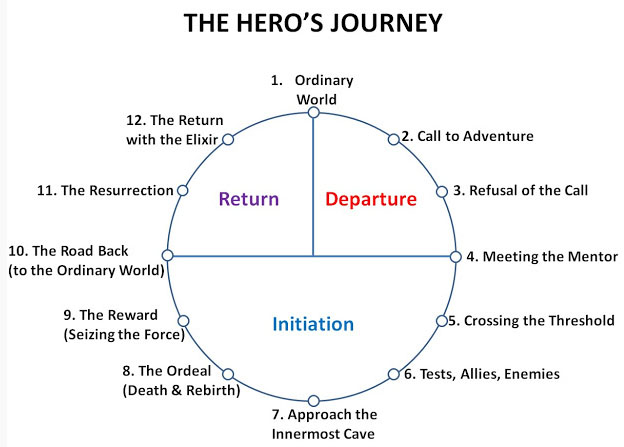
It is common to think about The Hero’s Journey as a circle. Your hero starts at the top, in their own world. They are pushed round into an unknown world, or a special world, where they discover they are capable of more than they thought.  

They undergo an internal transformation and return up to their old world a new and better person. 

the hero's journey

There are 12 steps to The Hero’s Journey: 

Step 1 – The ordinary world 

In this step your hero is perfectly content in their own world. They think they’ve got, if not everything, most of what they want and need. 

They don’t want to go on any adventures that will take them away from what is familiar and comforting. Bilbo Baggins is a perfect example. He doesn’t want to leave the Shire.

Step 2 – Call to adventure 

But life is never that good and before they know it, you call your hero to action. At first they refuse the calling. They want to stay where they are, thank you very much.

Bilbo is invited to join the Dwarves as their Burglar’. 

Step 3 – Refusal of the call 

Bilbo says no thank you, I’m only a Hobbit, I don’t have what it takes to carry out such an arduous task. 

Your hero will say the same thing. Even it’s not as dangerous as heading out to face a dragon it will be something they find hugely challenging and don’t want to to. 

Step 4 – Meeting the mentor 

In this step a third party appears and encourages, or pushes, your hero to accept that call to action. Persuaded, they somewhat reluctantly begin their journey. 

Gandalf is the one who persuades Bilbo to leave the Shire. 

Step 5 – Crossing the first threshold 

This is when your hero departs the old world, steps across the threshold and enters the unknown. 

Despite his better judgement, Bilbo follows the Dwarves on their adventure. 

Step 6 – Trials and tribulations 

The sixth step in your hero’s journey is encountering and overcoming many difficult trials and tribulations. 

These challenges push your hero to the limits. They are forced to do things they didn’t think they were capable of. Their strength and courage is tested to the max. 

Bilbo encounters Goblins, spiders, trolls and of course, Gollum. 

Throughout this period your hero re-encounters the person who pushed them into accepting the journey in first place. They also encounter a number of helpers along the way.  

These help helpers aid your hero to overcome the various challenges until they hit a point of revelation. During this revelation they discover things about themselves they didn’t know were possible and they shift from being the person they were before, to the person they were going to be.  

Think Elves, Eagles and Beorn.

tory structure the hero's journey

Step 7 – The inmost cave 

Here your hero comes face-to-face with one of their biggest fears and is put to their biggest test yet. 

 For Bilbo this is when he encounters the dragon. Let’s face it, that would be a tough day for anyone!

Step 8 – Ordeal 

Crisis point. This is when your hero is at their lowest or weakest ebb and doesn’t know whether they can carry on. At the last moment, they regroup, pull themselves together and are, essentially, reborn. 

In our Hobbit example, there is a battle at the bottom of the Lonely Mountain between five warring actions. Bilbo faces possible death.

Step 9 – The reward 

Your hero can sit back and enjoy the fruits of their labour. All that adventure, terror and near-death was worth it in the end. 

Bilbo fought well and is rewarded with a dagger of his own. He is also allowed to keep the gold ring. 

Step 10 – The road back

Depending on your story, you can add in a few more challenges and inner demons to overcome before the story is finished. 

In our example Bilbo heads back to the Shire, via Beorn’s home, with Gandalf.

This step is also known as Treasure. It is when the hero wins something. It could be a physical treasure, or it could be status or even a love interest.

Step 11 – Resurrection/Rebirth 

As the title suggests, your hero recovers with a new sense of identity, or, if they’ve faced a few more challenges on the road back, even from near-death.

In The Hobbit, Bilbo recovers from his adventures with a new sense of himself.

Step 12 – Return with the elixir 

Your hero returns home with a whole new vision of themselves and their world. 

Bilbo returns to the Shire a different Hobbit to the one who left. He’s no longer scared of the outside world outside. Plus, he has a dagger and a ring! 

Conclusion 

You have probably spotted this plot structure in many movies. Think of Luke Skywalker in Star Wars, or even Katniss Everdeen in The Hunger Games (which is also written in a clear three at structure). 

Even Harry Potter, young though he is, is called on The Hero’s Journey! 

Next week we will look at the third and final structure which is there Seven Point Story Structure 

If you’ve been working on your novel for years (perhaps even decades) the maybe it's time to consider working with a coach.

If you have multiple versions of your novel and you don’t know which works best, are scared nobody will like your book and don't feel like a 'real' writer, then my guess is coaching is the right next step for you.

Find out more and sign up for your free Clarity Call here: https://emmadhesi.com/personal-coaching/


emma dhesi

Emma Dhesi writes women’s fiction. She began writing seriously while a stay at home mum with 3 pre-school children. 

By changing her mindset, being consistent and developing confidence, Emma has gone from having a collection of handwritten notes to a fully written, edited and published novel. 

Having experienced first-hand how writing changes lives, Emma now helps beginner writers find the time and confidence to write their first novel.
Author Interview, Krystal Proffitt

Author Interview, Krystal Proffitt

Author Interview, Krystal Proffitt

If you’re nervous about starting your writing journey, this podcast episode is a must listen for you.  

Krystal Proffitt is an entrepreneur, podcaster and author. She hosts The Proffitt Podcast, which is all about how to start, launch and market your podcast. She is my mentor and started me on my own podcasting journey.  

Her motto is ‘We all have to start somewhere’ and this applies to me in podcasting, and you in novel writing.  

Author Interview, Krystal Proffitt

by Emma Dhesi | Turning Readers Into Writers

From time to time, I link to products or services I love using with affiliate links. This means that I may receive a small percentage or fee for referring you to any product you may purchase from one of those sites. It does not cost you anything. These small fees help sustain my small business. I truly appreciate your support.

emma dhesi krystal proffitt

Self-Discovery

Krystal used to work in the corporate world but after being a stay at home mum for a few years was ready to tackle something new and a journey of self-discovery led to The Proffitt Podcast and an unknown world of books.

First she discovered Julia Cameron’s The Artist’s Way and then Janet O’Connor’s Writing Down Your Soul, both of which encouraged her to start journalling.

She now has three journals – one for creative writing, one for gratitude and one for her poetry!

Krystal talks about a children’s book she wrote a few years ago, her experience of a writing conference and the world of pitching.

Take a chance!

Krystal’s exuberance will inspire you. Go with her her try it and see attitude to life, and see where it takes you.

She certainly inspires me with her energy and how open she is to life’s adventures.

I am sure she will do the same for you.

You can discover more about Krystal on Instagram, YouTube, and her podcast, The Proffitt Podcast.

If you’re interested in starting your own podcast, there’s no better place to start than with Krystal’s book, How To Start A Binge-Worthy Podcast.

If you’ve been working on your novel for years (perhaps even decades) the maybe it's time to consider working with a coach.

If you have multiple versions of your novel and you don’t know which works best, are scared nobody will like your book and don't feel like a 'real' writer, then my guess is coaching is the right next step for you.

Find out more and sign up for your free Clarity Call here: https://emmadhesi.com/personal-coaching/


emma dhesi

Emma Dhesi writes women’s fiction. She began writing seriously while a stay at home mum with 3 pre-school children.

By changing her mindset, being consistent and developing confidence, Emma has gone from having a collection of handwritten notes to a fully written, edited and published novel.

Having experienced first-hand how writing changes lives, Emma now helps beginner writers find the time and confidence to write their first novel.
Alliance of Independent Authors

Shortcuts for Writers


Do you feel as if you don’t have the time or the money to invest in editing your novel? I know an online course that can help you to transform your manuscript WITHOUT breaking the bank. It’s called Book Editing Blueprint: A Step-By-Step Plan To Making Your Novels Publishable, and it was created by Stacy Juba of Shortcuts for Writers. 


Story Structure Part 3: The 7 Point Story Structure

Story Structure Part 3: The 7 Point Story Structure

The 7 Point Story Structure

by Emma Dhesi | Turning Readers Into Writers

The 7 Point Story Structure

This is the second in a three-part mini-series on story structure. 

What is story structure anyway?    

As a reminder, story structure is the framework upon which you hang your novel. Structure gives your story backbone. It’s the set of rules upon which to build your story so it resonates with readers, drawing them in and holding their attention until the end.  

Part 1 

In Part 1 you looked at The 3 Act Structure. It’s the oldest and most commonly used. It’s nice and simple and is the one I teach my students. In that article we used a hypothetical storyline as the example. 

Part 2 

In Part 2 you looked at the 12 steps of Joseph Campbell’s The Hero’s Journey, using JRR Tolkein’s The Lord Of The Rings as the example. 

Part 3 

This week you’re learning about the 7 Point Story Structure as developed by Dan Wells. In this article we will use Harry Potter And The Philosopher’s Stone. 

The 7 Point Story Structure  

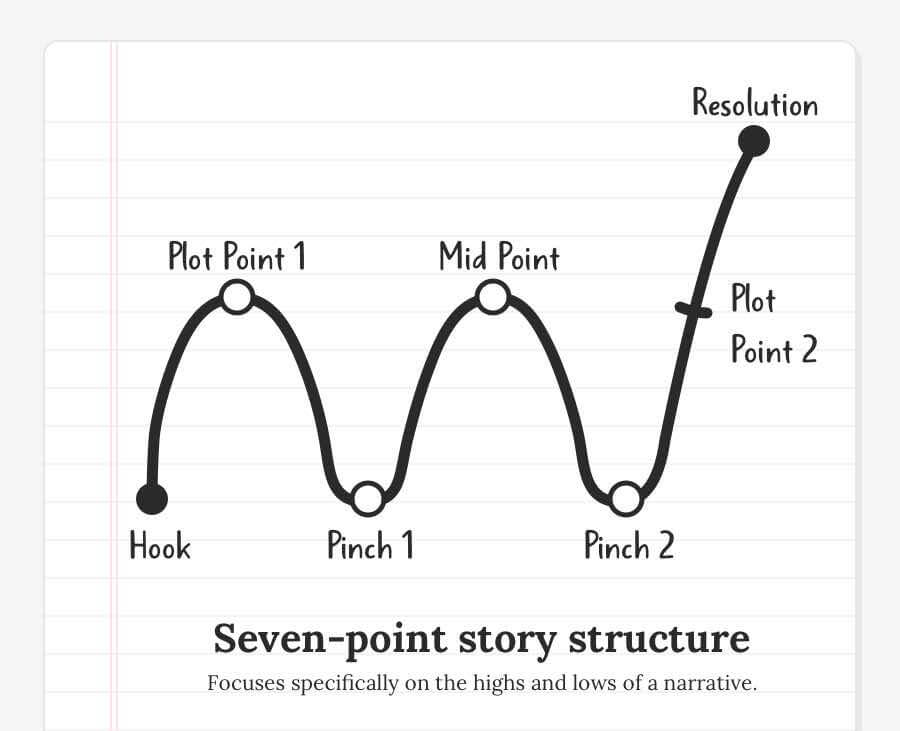
This 7 point story structure is so named because it comprises 7 important elements that build out your novel’s story arc. 

7 point story structure

From time to time, I link to products or services I love using with affiliate links. This means that I may receive a small percentage or fee for referring you to any product you may purchase from one of those sites. It does not cost you anything. These small fees help sustain my small business. I truly appreciate your support.

Point 1 – Hook 

This is your character’s starting point and where the reader enters the story. We learn about your character’s normal world. You want them to be the opposite of where they will end up. 

Harry Potter starts the book as an abused and isolated boy who feels he has no place in the world. That is not where he finishes in the story arc. 

Point 2 – First Plot Point 

This is the event that kicks the story into motion and begins your hero’s journey to the midpoint. You inflict a little pain on your protagonist, it makes life difficult and forces them out of their normal life and into the story. 

Harry learns that he is a wizard and enters Hogwarts. 

Point 3 – Pinch Point 1 

This is where you are really mean to your hero and something bad happens to them. The usual way to do this is bring them face-to-face with their antagonist. 

Harry comes face-to-face with a troll, which he and his friends defeat. 

Point 4 – Midpoint 

Until now your character has not wanted to be on this journey, they’ve been reluctantly taking part, reacting to situations as they arise. At the Midpoint, all that changes. They switch from being reactive to being proactive. 

They understand they must defeat their nemesis, and the game is on! 

Even though it’s called the Midpoint, it doesn’t necessarily take place in the middle of your story. A good example of this is when a detective takes on a case early in the story, or the girl realizes later in the book that her male friend is really the love of her life and she makes a play for him. 

For Harry it’s when he realizes Voldemort is after the Philosopher’s Stone and he knows he must protect it. 

7 point story structure

Point 5 – Pinch Point 2 

More pressure is added to your character and they hit their rock bottom.  

They are experiencing their darkest moment and feel they’ve lost everything. It is hard for them to pick themselves up and carry on with their journey. 

For Harry, this is when Ron and Hermione are trapped and can’t continue with him. Harry must face his foe alone. A very low moment for him. 

Point 6 – Second Plot Point 

Finally, your character realizes they have what it takes to defeat the antagonist. Everything slots into place and are ready to achieve their goal.  

Now all they have to do is their plan into action. 

For Harry, this is when he looks into the magic mirror, realizes he has a pure heart and can defeat Voldemort. 

Point 7 – Resolution 

This is the climax of the story, when your character defeats their antagonist and wins the day.  

It may be that they don’t get what they want, but what they need. So, for example, your hero might not find the treasure, but they discover an inner strength they never knew they had. 

Not only does Harry defeat Voldemort, but he has transformed from that lonely boy under the stairs to someone who has friends and purpose in life. 

Work backwards 

Many recommend that with the 7 Point Story Structure you have to start from the resolution and work backwards for this structure to be most effective.  

It is thought that by doing it this way you ensure your character starts the book at the opposite end of the story arc. It is also the best way to plan your character’s arc, not just the story arc. 

Conclusion 

I confess the 7 Point Story Structure is my least favourite of the 3 structures, but I can see how other’s may like it. There are not as many steps to follow as in the Hero’s Journey, but gives a little more direction that the 3 Act Structure. 

You’ve probably noticed that all 3 of these structures intertwine and that you can apply almost every story to any one of them. 

What this tells you is that no one structure is correct. Different systems appeal to different people and seem to sit much more comfortably with particular genres. 

For example, the 3 Act structure sits well with literary fiction, The Hero’s Journey with fantasy and the 7 Point Story Structure with YA. 

Which resonates best with you? Have you been using one method up until now but are intrigued to try out a new one? Let me know in the comments section below. 

If you’ve been working on your novel for years (perhaps even decades) the maybe it's time to consider working with a coach.

If you have multiple versions of your novel and you don’t know which works best, are scared nobody will like your book and don't feel like a 'real' writer, then my guess is coaching is the right next step for you.

Find out more and sign up for your free Clarity Call here: https://emmadhesi.com/personal-coaching/


emma dhesi

Emma Dhesi writes women’s fiction. She began writing seriously while a stay at home mum with 3 pre-school children. 

By changing her mindset, being consistent and developing confidence, Emma has gone from having a collection of handwritten notes to a fully written, edited and published novel. 

Having experienced first-hand how writing changes lives, Emma now helps beginner writers find the time and confidence to write their first novel.